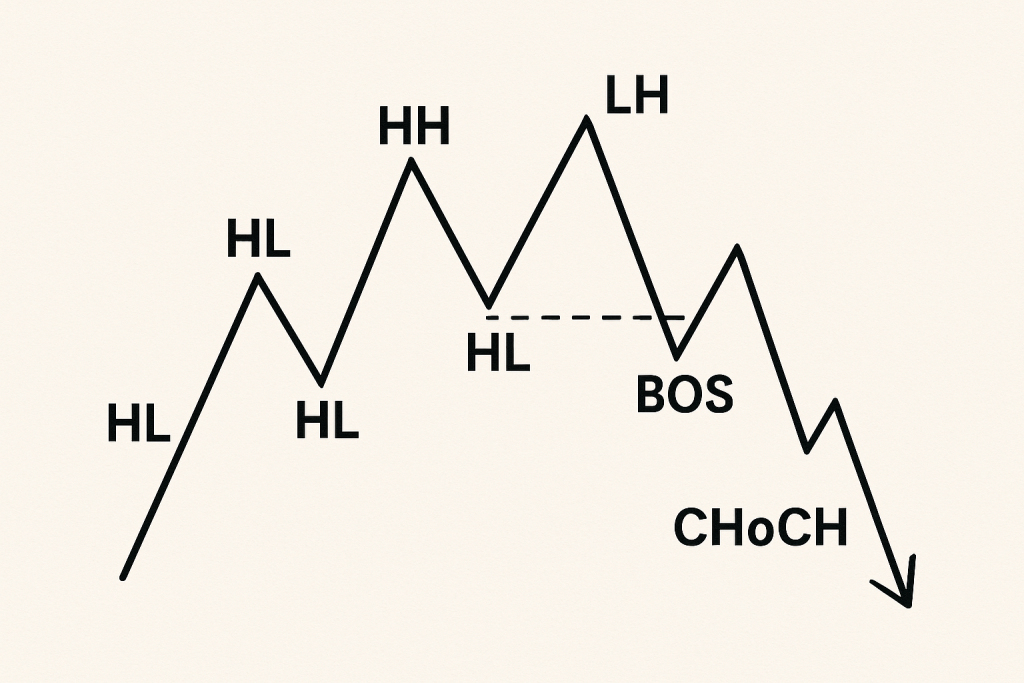
Market structures are the backbone of price action trading. Long before the internet, indicators and fancy names, traders were already watching sequences of higher highs and higher lows to define an uptrend, and lower highs and lower lows to define a downtrend. Modern terms like BOS (Break of Structure) and CHoCH (Change of Character) are simply new labels for an old idea: the moment when the sequence of highs and lows continues or flips.
In this article we will unpack what market structure really is, how BOS and CHoCH fit into that picture, why CHoCH is not a new invention or a secret method owned by any group, and how a serious trader can use these concepts in a practical, rule based way.
What market structure actually measures
At its core, market structure is a simple sequence question: are buyers pushing price to new highs and defending pullbacks, or are sellers pushing price to new lows and capping rallies. On a naked chart, you can read this directly from swing points.
| Environment | Highs | Lows | Basic interpretation |
|---|---|---|---|
| Uptrend | Higher highs (HH) | Higher lows (HL) | Buyers in control, demand winning |
| Downtrend | Lower highs (LH) | Lower lows (LL) | Sellers in control, supply winning |
| Range | Flat highs | Flat lows | Balance, neither side clearly in charge |
When you mark the swing highs and lows and connect them like a staircase, you can immediately see whether you are aligned with the current flow or fading it. Market structures give you three crucial pieces of information
- Direction: whether the current sequence is bullish, bearish or neutral.
- Location: where current price sits relative to recent highs and lows.
- Invalidation: which swing level must break to prove that the current narrative is wrong.
Out of these, invalidation is the most important for risk management. A trader who knows where the structure breaks has a natural place to accept loss and step aside.
From structure to BOS and CHoCH
Once you accept that structure is just a sequence of highs and lows, BOS and CHoCH become easy to define. They are names for specific events in that sequence.
Break of Structure (BOS)
In a bullish environment with higher highs and higher lows, the key reference is the most recent higher low. If price pushes above the last swing high, we talk about a bullish BOS: the trend is continuing and buyers are still strong. In a bearish environment, a break below the previous swing low is a bearish BOS.
BOS therefore usually describes trend continuation. It is the market saying: the same side is still in control and has just extended the move further.
Change of Character (CHoCH)
CHoCH, or Change of Character, is a label many traders use for the first structural sign that the current trend might be ending. In a clear uptrend, the first meaningful break of a prior higher low suggests that buyers are no longer completely in charge. In a downtrend, the first meaningful break of a prior lower high suggests that sellers may be losing control.
The key word is meaningful. A minor spike that barely pokes through a level in illiquid conditions is very different from a strong impulsive move that closes decisively beyond a reference swing. A sensible definition of CHoCH always combines price behaviour, candle closes and context.
One common practical distinction is
- BOS in the direction of the existing trend reinforces trend continuation.
- CHoCH against the existing trend warns that the market might be transitioning into a range or a reversal phase.
Different educators use slightly different rules, but the underlying logic remains the same: BOS and CHoCH are both just structural labels on the same staircase of highs and lows.
CHoCH is not a new invention or a secret method
There is a tendency in trading education to take old ideas, wrap them in fresh vocabulary and present them as a proprietary system. Market structures and CHoCH are a clear example of this. Long before the term existed, classical trend analysis and early Dow theory were already using the same logic: a bull trend is a sequence of higher highs and higher lows; when that sequence breaks, something has changed.
The modern CHoCH label is not owned by any brand, group or community. It is simply shorthand for a structural shift that price technicians have been watching for decades. Renaming it does not turn it into a secret edge; it only and hopefully makes traders pay more attention to where trends actually break.
For a serious trader, this is good news. You do not need membership in any private circle to use market structures. You need a clean chart, a disciplined eye for swings and a consistent rule set for what you call a BOS and what you call a CHoCH.
Using market structures across multiple time frames
Market structures become much more powerful when you combine several time frames. A typical workflow uses three layers
- Higher time frame (weekly or daily) to define the major bullish, bearish or ranging environment.
- Intermediate time frame (for example, H4 or H1) to see the swing structure you will trade with.
- Execution time frame (M15, M5, or lower) to refine entries at precise levels.
When the higher time frame shows higher highs and higher lows, you focus mainly on long setups. You then watch the intermediate time frame for a local CHoCH against the major trend to end a pullback, followed by a BOS back in the trend direction. On the execution time frame you look for confirmation patterns, such as rejection wicks or strong continuation candles.
Here the language does not matter. You could label these events BOS, CHoCH or simply say break of key low and resumption. What matters is that the logic is consistent. Market structures on the bigger chart keep you aligned, while smaller time frame structures allow you to time entries and exits efficiently.
Practical trading rules around BOS and CHoCH
To convert the concept into a rule based approach, you can adopt simple guidelines such as
- Define exactly how many candles or how much distance a swing must travel to count as a valid high or low.
- Require candle closes beyond a swing level to qualify as BOS or CHoCH, instead of reacting to the first wick that taps the line.
- Use the latest structural low in an uptrend, or the latest structural high in a downtrend, as the natural place for your protective stop.
- Combine structural signals with other tools, such as support and resistance zones, supply and demand areas or volatility measures, rather than using structure alone.
In this way, Market structures guide your overall decision making, while the details of your entry and risk management are supported by additional evidence.
Common mistakes with CHoCH and structure
Many traders misuse CHoCH and BOS because they chase the label instead of respecting the underlying logic. Typical errors include
- Calling every tiny spike above a high or below a low a CHoCH, leading to constant flip flopping between long and short.
- Ignoring the higher time frame context and taking a minor CHoCH on a one minute chart as if it cancelled a strong daily trend.
- Forcing labels on messy ranges where there is no clean sequence of highs and lows to begin with.
- Believing that the word CHoCH has power on its own, instead of understanding that it is just a description of price behaviour.
The antidote is discipline. Decide in advance what qualifies as a swing, what qualifies as a structural break and how many time frames you will track. Then apply the same definitions every day, regardless of market noise or social media memes.
Conclusion
Market structures are a simple but powerful way to read who is in control of price. Higher highs and higher lows tell you that buyers dominate; lower highs and lower lows tell you that sellers dominate. BOS and CHoCH are just convenient labels for extensions and breaks in that sequence, not mystical signals or private formulas.
CHoCH, specifically, is nothing more than the first meaningful sign that the existing trend is losing its grip. Used well, it helps you see when a trend is likely to pause, range or reverse. Used poorly, it becomes an excuse to overtrade every small flicker.
By grounding your analysis in clean Market structures, being precise about what you call BOS and CHoCH, and combining structure with sound risk management, you turn an old, public concept into a robust framework for modern trading.