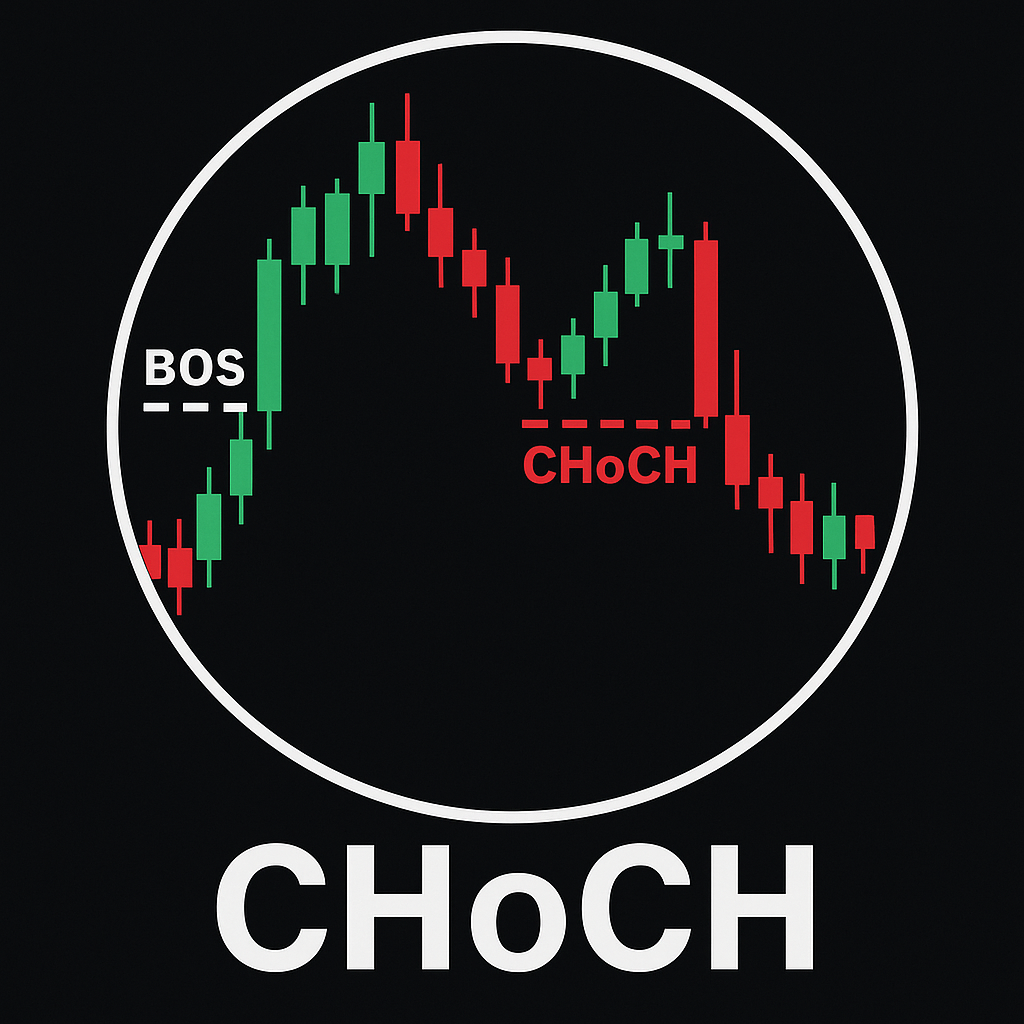
Change of Character (CHoCH) describes the first meaningful break in a trend's structure. While a Break of Structure (BOS) confirms that an existing trend is intact, CHoCH highlights the moment when that trend stops behaving normally and starts to look vulnerable. It is simply a structured way of expressing an idea that traders have used for more than a century: a trend is valid while it keeps making higher highs and higher lows in an uptrend, or lower highs and lower lows in a downtrend, and it is suspect the moment that rhythm is broken.
Not a secret concept or a new invention
CHoCH is often presented today under smart-money or institutional trading labels, as if it were a proprietary discovery belonging to a closed group. Historically, nothing could be further from the truth. Long before modern acronyms, Dow theory and classic trend analysis already defined a change of character as the first failure of a trend to maintain its sequence of highs and lows. The modern name may be new, but the underlying logic is old and universal: structure breaks first on the lower time frames, and that is where early evidence of reversal appears.
This matters for psychology. When a trader believes CHoCH is a mystical pattern owned by a small community, they tend to overcomplicate it and ignore the essential core: we are just measuring whether the current dominant side still controls the market. The chart does not know labels, courses or groups. It only knows whether buyers are still able to defend their last higher low, or whether sellers are still able to defend their last lower high.
CHoCH versus Break of Structure (BOS)
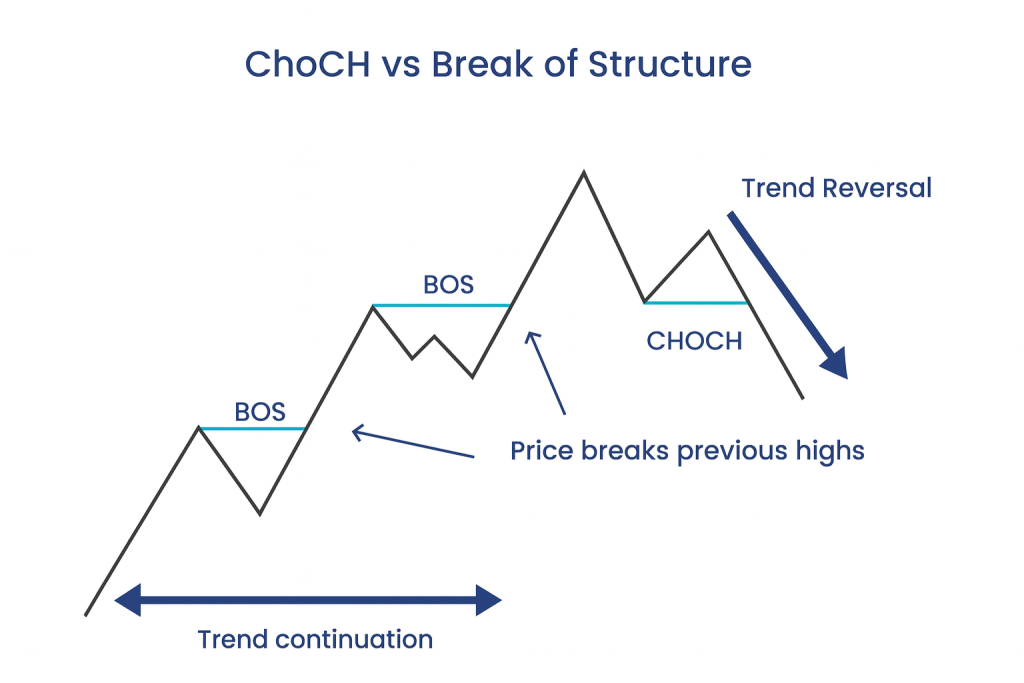
CHoCH and BOS work together, not against each other. BOS confirms continuation of the current trend; CHoCH signals the first credible attempt to reverse that trend. A simple way to see the difference is to think in sequences
- In a healthy uptrend, price makes a series of higher highs (HH) and higher lows (HL). A close above the previous HH is a bullish BOS.
- The first time price breaks below a prior HL and prints a clear lower low (LL), the market prints a CHoCH and warns that buyers may be losing control.
- In a healthy downtrend, price makes lower lows (LL) and lower highs (LH). A close below the previous LL is a bearish BOS.
- The first time price breaks above a prior LH and prints a clear higher high (HH), a bullish CHoCH appears and warns that sellers may be losing control.
BOS says, "trend intact, carry on". CHoCH says, "something has changed, pay attention". Professional traders track both because together they form a structured narrative of how control shifts between buyers and sellers.
Comparison table: BOS and CHoCH
| Aspect | Break of Structure (BOS) | Change of Character (CHoCH) |
|---|---|---|
| Main purpose | Confirms continuation of the current trend | Signals a potential shift from trend to reversal |
| Location in sequence | Occurs repeatedly as trend prints new extremes | First meaningful violation of previous swing structure |
| Typical action | Look to trade pullbacks in the trend direction | Prepare to switch from continuation setups to reversal setups |
| Risk implication | Existing trend stop locations stay valid | Old invalidation levels may no longer be reliable |
How to identify CHoCH step by step
To keep CHoCH practical, define it using clear, mechanical steps. One robust approach is
- Identify the current trend using swing structure on a chosen time frame. Label the most recent confirmed swing highs and lows.
- Mark the key reference point: in an uptrend it is the latest higher low; in a downtrend it is the latest lower high.
- Wait for price to close decisively beyond that reference point, not just wick through it.
- Confirm that the market then follows through by printing the opposite type of swing: a lower high and lower low after a broken higher low, or a higher low and higher high after a broken lower high.
- Once this new sequence appears, accept that character has changed on that time frame and abandon old continuation assumptions.
The emphasis on closing prices and follow-through is critical. Markets often probe liquidity beyond a level and then snap back into trend. Without confirmation, many traders confuse simple liquidity grabs with a genuine CHoCH and are repeatedly shaken out of otherwise healthy trends.
Multi-time-frame context for CHoCH
Like all structural tools, CHoCH becomes far more powerful when used in a multi-time-frame framework. A typical playbook looks like this
- Use the higher time frame (for example daily or four-hour) to define the main trend and to mark major supply and demand zones.
- On the execution time frame (such as one-hour or fifteen-minute charts), wait for a CHoCH to occur as price taps a higher-time-frame zone.
- Treat this local CHoCH as an early warning that the higher-time-frame level is starting to react and that a rotation in price may be underway.
In this way, CHoCH is not an isolated signal but a bridge between big-picture context and fine-tuned entries. A single CHoCH in the middle of nowhere on the chart is weak information; a CHoCH that appears exactly where higher-time-frame participants are expected to defend their positions carries far more weight.
Blending CHoCH with supply, demand and fair value gaps
Most advanced price-action models combine structure with supply and demand zones, order blocks and fair value gaps. One common example is
- Price rallies into a well-defined higher-time-frame supply zone after an extended uptrend.
- On a lower time frame, the market prints a CHoCH: the last higher low is broken, followed by a lower high and a lower low.
- The breakdown leg often leaves behind a fresh lower-time-frame supply block or a fair value gap above price.
- Traders then look for a retrace back into that block or gap to position short with stops beyond the invalidation level.
This framework uses CHoCH as a trigger, the fresh supply or demand zone as an entry location, and the original higher-time-frame level as macro context. When all three align, the setup is structurally coherent: large players defend their zone, character changes locally, and the pullback provides efficient risk-to-reward.
Risk management around CHoCH
No structural signal, including CHoCH, removes the need for sound risk management. Several practical rules help keep it under control
- Size positions assuming that CHoCH can fail. A trend can briefly lose structure and then reassert itself; stops must be placed at levels that admit this possibility but still protect capital.
- Avoid entering purely on the first break. Waiting for a retrace and rejection inside a clear zone usually offers both better pricing and clearer invalidation.
- Track which time frame generated the CHoCH. A five-minute CHoCH against a strong daily uptrend is weaker than a four-hour CHoCH aligned with a weekly supply zone.
- Update invalidation logic. Once a valid CHoCH prints, using the old trend swing points as if nothing happened is dangerous; the market has already signalled that prior anchors are compromised.
Common mistakes when using CHoCH
Traders make several recurring errors around CHoCH. Recognising them early saves both money and frustration
- Forcing structure where none exists. In extremely choppy markets, the sequence of highs and lows is too messy to label cleanly. Forcing a CHoCH in that environment turns a useful concept into noise.
- Ignoring the quality of swings. Tiny micro-swing breaks inside overlapping candles carry less weight than clean, obvious turns that everyone can see.
- Confusing liquidity grabs with structural change. A wick through a level without a decisive close and follow-through is usually just a stop hunt, not a change of character.
- Detaching CHoCH from context. A textbook CHoCH against higher-time-frame momentum and away from any important level is far weaker than an imperfect but well-located shift at a major zone.
- Over-leverage. Believing that CHoCH is a near-certain reversal signal encourages oversizing. In practice, it is a probabilistic clue that must still be combined with confluence and proper position sizing.
Building a CHoCH-based trading checklist
To make this concept actionable, many traders formalise it into a short checklist that must be satisfied before taking a reversal trade. An example checklist could be
- Is price currently testing a higher-time-frame supply or demand zone?
- Has the local trend on the execution time frame produced a clear CHoCH with a decisive close beyond the key swing point?
- Did the move that created CHoCH leave behind a fresh zone or fair value gap that can serve as an entry area?
- Is there supporting evidence from tools such as volume, momentum or divergence, or is structure acting alone?
- Is the planned stop logically placed beyond invalidation and sized within overall risk rules?
By insisting on this type of structure, a trader avoids impulsively reversing on every small break and instead focuses on the clearest, best-located changes of character.
Conclusion
Change of Character (CHoCH) is simply a modern label for a timeless principle: trends are defined by the rhythm of their highs and lows, and the first credible break of that rhythm is where control may start to shift. It does not belong to any private group or methodology; it is just disciplined reading of price behaviour. Used in isolation it is incomplete, but combined with multi-time-frame analysis, supply and demand, fair value gaps and strict risk management, CHoCH becomes a powerful lens for understanding when to stop treating every pullback as a buying opportunity and start preparing for the possibility of true reversal.