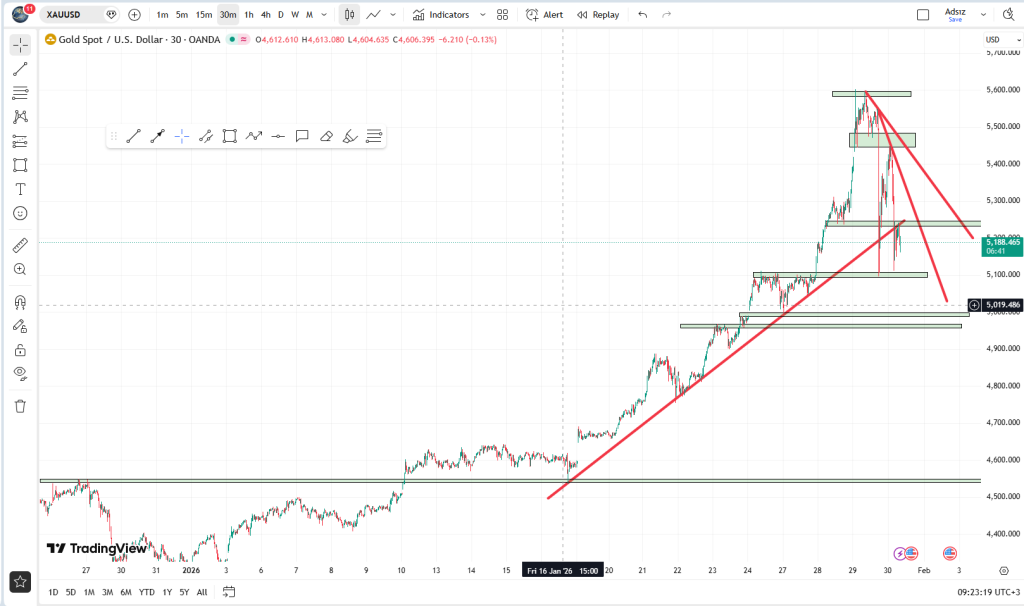
XAUUSD Overnight Drop: What Triggered the Slide
XAUUSD did not fall because the world suddenly decided gold is no longer valuable. The move fits a much more familiar pattern: an overheated rally reached a fresh record high, the market started taking profits, and then a second wave of selling hit as a policy narrative shifted toward a tighter liquidity regime. In short, it was a crowded trade getting unwound in a headline-driven volatility window.
What Actually Changed Overnight
Two sessions matter for understanding this drop. First, gold pushed into record territory and then slipped as profit-taking kicked in. Reuters described that initial reversal from the highs as investors taking profits after the metal became stretched and speculative interest grew across precious metals.
Second, the decline deepened when the market began pricing a higher probability that the next Federal Reserve chair could be more hawkish than the current policy stance. Reuters explicitly linked Friday’s sharper selloff to rising bets of a more hawkish Fed chair, alongside a firmer dollar. That combination is mechanically negative for gold in the very short term because it tends to lift real-rate expectations and stabilizes (or strengthens) the USD, reducing the immediate appeal of a non-yielding asset.
Was There a Specific Data Release at the Moment the Drop Started
This is the part where traders often fool themselves: they assume every sharp move must have been caused by a scheduled macro release. In the contemporaneous reporting on this move, the first turn down from the record highs was framed as profit-taking and overbought conditions rather than a reaction to a single named economic data print. Reuters’ coverage of the initial reversal emphasized profit-taking after record highs and the broader risk context, not a particular data release that hit the tape at the exact inflection.
That does not mean macro data was irrelevant. It means the dominant proximate trigger described by major coverage was positioning behavior (profit-taking, stop cascades) and a rapidly evolving policy narrative (Fed leadership expectations), with the dollar firming as a transmission channel. In other words, the drop began like many late-stage rallies end: sellers did not need a perfect macro shock, they only needed the rally to be stretched and for a credible reason to reduce risk to appear.
The Three-Stage Mechanism Behind the Selloff
1) Profit-taking after a parabolic run
Gold had moved so far, so fast, that the market’s marginal buyer was increasingly a short-term participant rather than a long-horizon allocator. In those conditions, when price stops going up easily, the first wave of selling is often simple profit-taking. This creates the initial air pocket: price falls into the nearest demand zone, stops get hit, and the drop feeds on itself. Reuters highlighted that gold was overbought and still headed for an extraordinary monthly gain even after the drop, which is exactly the profile that produces sharp corrections: strong long-term trend, fragile short-term positioning.
2) USD stabilization and the real-rate narrative
Once the dollar stops weakening and begins to rebound, gold loses a major tailwind. Reuters noted the dollar recovered slightly after the Fed left rates unchanged midweek, contributing to the pressure on gold as traders recalibrated expectations. This does not require actual rate hikes; it only requires the market to reduce the probability of an easier policy path in the near term.
3) Fed-chair speculation as a liquidity shock
The key accelerant was not a CPI or payroll print. It was the market’s perception of a potential regime shift in Fed leadership and balance-sheet philosophy. Reuters’ reporting on the broader risk-off tone showed that the same Fed-chair speculation hit other risk-sensitive assets like crypto, reinforcing that this was a cross-asset liquidity narrative, not a gold-only story. When markets think the future Fed could be more hawkish and more inclined toward tighter liquidity, high-beta assets and crowded trades often sell first, and even classic havens can drop if investors are de-leveraging.
What the World Is Pricing Next
After a move like this, markets tend to obsess over two things: (1) whether the policy narrative hardens into a durable expectation, and (2) whether the selloff was primarily a positioning flush or the start of a longer distribution phase. Current coverage suggests the world is focused on policy credibility and the implication of Fed leadership uncertainty, while geopolitics remains a background support for precious metals even as day-to-day price action whipsaws.
That produces an unstable but interpretable environment: news that strengthens the case for tighter liquidity (hawkish leadership signals, sustained USD bid) tends to cap gold rallies; news that increases systemic or geopolitical anxiety tends to support deeper pullbacks and attracts strategic dip buyers. Importantly, these forces can be true at the same time, which is why price action becomes violent and non-linear.
How This News Context Maps to Your Chart
Your 30-minute chart shows a classic transition from trend to volatility regime: a strong impulsive rally into a top supply zone, followed by a sharp drop and a fast rebound attempt with long wicks. That is exactly what a liquidation-driven correction looks like: price does not glide to the next level, it spikes through it and snaps back because the market is hunting liquidity, not respecting clean technical geometry.
The key idea is this: if the drop is mainly a positioning flush, price will start building a base above a major demand band and will reclaim an important pivot area with closes and retests. If the drop is a true distribution transition, rebounds will be sold aggressively below the pivot, and price will keep printing lower swing highs while revisiting deeper demand zones. Reuters’ framing of the move as overbought profit-taking plus hawkish-policy repricing supports the view that volatility is elevated and mean reversion is likely, but it does not guarantee immediate trend resumption.
The Practical Level Logic (Without Repeating the Old Write-up)
Instead of re-listing the same zones, use this decision logic
- Pivot zone behavior decides the bias: If price reclaims the mid-structure pivot and can hold it on retest, the correction is more likely to resolve into a continuation attempt.
- Failed rebounds signal distribution: If every rebound into the prior pivot is rejected with weak closes, sellers are still in control and deeper demand is in play.
- Wicks are not confirmation: In this volatility regime, wicks mostly mean forced flows. Confirmation comes from consecutive closes and clean retests.
This logic matches what typically happens in headline-driven liquidity events: the market tests where liquidity sits, not where a textbook pattern says it should go.
Consensus View Across Coverage
Different commentators and outlets emphasize different angles, but their overlap is tight
- The bigger move that preceded the drop was extraordinary (gold still tracked toward its strongest month in decades), which makes a fast correction structurally plausible.
- The first selloff impulse was profit-taking from records rather than a single named data print at the inflection.
- The deeper slide was amplified by a hawkish Fed-chair narrative and a firmer USD, which tightened the short-term financial-conditions outlook and pressured crowded positioning.
So the common conclusion is straightforward: XAUUSD sold off because the market moved from one dominant story (safe-haven demand plus a weak dollar and a powerful momentum bid) to a competing story (tighter liquidity risk via Fed leadership expectations). When those stories collide in an overbought tape, the result is a fast unwind, not a polite pullback.
What to Watch Over the Next 24–72 Hours
In this regime, a single headline can move price more than a technical pattern can. The most informative signals are cross-asset and policy-linked
- USD tone: Does the dollar keep firming, or does it fade quickly after bounces?
- Risk proxy behavior: If risk assets and high-beta instruments remain pressured on the same narrative, gold can stay choppy even if it remains supported longer term.
- Follow-through on the hawkish story: Do credible policy signals confirm the hawkish expectation, or does it stay as rumor-driven noise?
- Structure rebuilding: Does price reclaim and hold the pivot area with clean retests, or do rebounds keep failing?
This is the correct framing for a drop like this: treat it as a volatility and narrative battle, then let price confirm whether it is building support or distributing lower.
Conclusion
The XAUUSD overnight drop was not a mystery event and not, based on the contemporaneous coverage, a reaction to a single scheduled data release at the exact moment the decline began. The initial reversal from record highs was described as profit-taking in an overbought market, and the deeper leg lower was tied to a firmer dollar and rising speculation that the next Fed chair could be more hawkish, which tightened the short-term liquidity narrative across markets.
Practically, that means the chart should be read as a regime shift from trend to headline-driven volatility. The next phase will be decided by whether price can rebuild structure above key pivots (suggesting a positioning flush inside a larger bull trend) or whether rebounds continue to fail (suggesting broader distribution). Either way, the clean takeaway is this: the move was driven by positioning plus policy uncertainty, not by a single economic number printing on the calendar.