The “No-Sellers” Rally: Why Gold Keeps Trapping Shorts Above $5,000
Gold has entered a new regime. The market has surged through the $5,000 psychological barrier and printed fresh record territory near $5,100, driven by a renewed safe-haven bid and a rapidly rising geopolitical risk premium.
This move is often misdiagnosed as “too many buyers.” The cleaner explanation is harsher: the rally is being powered by the absence of sellers. When offers thin out, even ordinary demand can lift price aggressively—and every short position becomes future forced buying.
1) Geopolitics: Iran–U.S. Tension Adds a Real Risk Premium
The Iran–U.S. story is not just headline noise; it is an uncertainty engine. Reuters reported President Trump saying an “armada” was heading toward Iran, alongside reporting that U.S. naval assets were expected to arrive in the region in coming days.
The spillover is visible in real-economy behavior: Israeli airlines eased cancellation terms due to uncertainty linked to Iran tensions—an example of how risk perception travels beyond markets.
In this environment, gold behaves less like a commodity and more like insurance. Insurance gets more expensive precisely when outcomes become harder to model—policy shocks, escalation risk, and unpredictable decision-making.
2) Macro Catalyst: Fed Week Can Add Volatility, Not Necessarily a Trend Reversal
With a Federal Reserve meeting ahead, short-term chop and profit-taking attempts are normal. Reuters noted the upcoming Fed meeting as part of the backdrop while gold pushed into record highs.
The key distinction: volatility does not automatically create a meaningful correction. Corrections require persistent sell flow. If the market is in a “seller’s strike,” pullbacks tend to be shallow and quickly absorbed.
3) The Core Mechanism: Price Rises Because Sellers Step Aside
“Buying pressure” is not the whole story
A market can rise sharply without a mythical wave of buyers if the sell side simply disappears. Thin offers mean price must travel higher to find liquidity.
Shorts become the most reliable future buyers
In runaway trends, short sellers provide the market’s most predictable demand: covering. When price refuses to correct, “fade strength” strategies compound into a crowded short inventory. The break of a major level (like $5,000) then triggers stop-outs and margin pressure—turning shorts into forced buyers and accelerating the rally.
Why the “no correction” feel is rational
What feels like “price won’t pull back” is often just a structural condition: insufficient selling interest at/near prior levels. Reuters described expectations that pullbacks may occur but demand remains strong—consistent with a trend that punishes premature mean-reversion trades.
4) Linked Markets: This Is a Precious-Metals Complex Move
Silver (XAGUSD): Above $100, acting like high-beta gold
Silver crossed $100 andhigher, reinforcing the broader hard-asset bid.
Supply narrative matters: China export controls tighten the perception of availability
China has been managing silver exports through a controlled list of allowed exporters—an important nuance for markets that price “availability,” not just “production.”
Broad complex strength
Reuters also reported strong moves in platinum and palladium alongside gold and silver—evidence of a wider “hard-asset” repricing rather than a single-instrument anomaly.
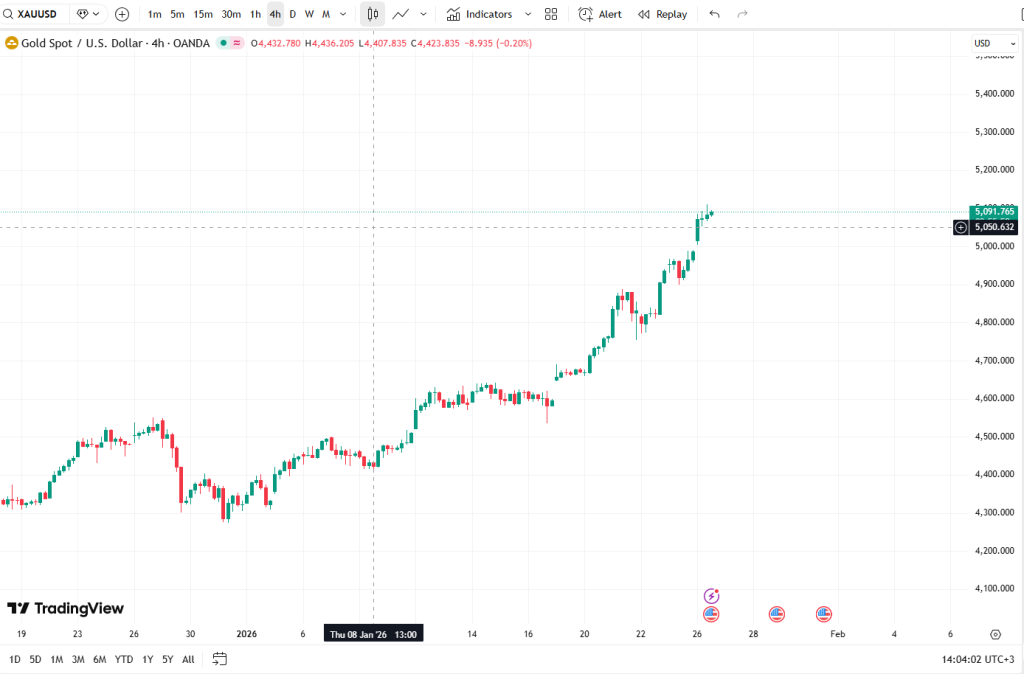
5) Technical Read: What Today’s 4H Chart Is Actually Saying
On the 4H structure, the trend is a textbook “stair-step” with brief pauses and fast continuation—classic behavior in a no-sellers environment.
Current 4H candle snapshot (from today’s print):
- O: 5,084.230
- H: 5,095.115
- L: 5,078.435
- C (last): 5,089.850
This is not a reversal candle; it is tight consolidation at altitude—the market holding gains above a major psychological threshold rather than mean-reverting below it.
Practical zones (as behavior, not magic numbers):
- 5,000–5,050: breakout shelf / psychological support band
- 4,900 area: prior expansion base (a deeper pullback would likely need new sell catalysts)
- Above 5,100: price discovery; liquidity pockets can cause sharp extensions and abrupt spikes
6) The “Weirdness” of 2026 So Far: Why This Trend Feels Unfair
What looks “weird” is simply a regime shift: gold moved from a choppy, two-sided market into bullish acceleration. In that phase, the market often stops offering clean dip entries because dips are not produced by calm sellers—they are produced by forced liquidation. When liquidation is absent, retracements compress.
Add three accelerants
- Geopolitical tail risk (Iran–U.S. uncertainty)
- Macro uncertainty + policy risk (safe-haven reflex)
- Crowded short behavior (forced buying when levels break)
That combination creates the exact price action visible on the chart: a market that climbs because it cannot find sellers at prior prices.
7) What Could Actually Break the “No-Sellers” Structure?
This is not “up forever.” The no-sellers condition ends when sellers return—typically via one of the following
- Credible geopolitical de-escalation (risk premium bleeds out)
- A meaningful USD reversal / macro repricing that makes holding gold less attractive (relative carry/real-rate dynamics)
- Institutional profit-taking large enough to restore two-sided liquidity (offers reappear)
Until that happens, fading strength is structurally disadvantaged: it is fighting both the trend and the mechanics of forced short covering.
Bottom Line
Gold’s rally above $5,000 is not best explained by “everyone buying.” It is better explained by not enough people selling, with shorts repeatedly forced to cover into strength—while geopolitics and macro uncertainty keep the safe-haven floor firm.
Risk note: This is market commentary, not investment advice. Leverage can liquidate correct analysis with incorrect timing.