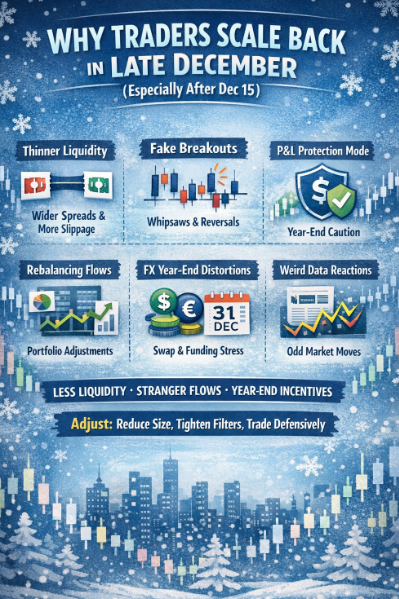
Late December isn’t “mystically bad.” It’s mechanically different.
Across FX, indices, commodities—and even parts of crypto—many discretionary and institutional traders reduce activity after mid-December. This isn’t superstition. It’s market microstructure plus incentives: liquidity thins, execution quality degrades, and year-end performance dynamics push professionals into capital preservation mode.
If you trade short timeframes (especially M1/M5), this regime change hits harder because your edge is built on tight spreads, consistent fills, and clean follow-through.
1) Liquidity Thins → Spreads Widen → Slippage Increases
As desks move into holiday staffing, fewer large participants quote meaningful size. The practical outcomes are immediate
- Wider spreads: The best bid/ask sits further apart.
- More slippage: Stops and market orders fill worse than expected.
- Higher market impact: Smaller orders move price more than usual.
Your chart may still print the “same setup,” but the trade you actually get is lower quality—often enough to turn a marginally profitable approach into a break-even (or negative) one.
2) More Whipsaws and Fake Breakouts
With less depth, price becomes easier to push around—not necessarily by “manipulation,” but by normal flows acting in thin conditions
- short-horizon algos sweeping liquidity
- stop clusters triggering in shallow books
- options hedging flows
- time-based execution (notably in FX fixes).
The classic late-December behavior shows up more often: breakout → immediate reversal. In many cases it’s simply thin order books plus flow-driven bursts, not a clean directional auction.
3) Year-End Incentives: P&L Protection Mode
This is the unglamorous core.
For many institutions, year-end results drive compensation, risk budgets, and internal rankings. Once a desk is comfortably positive on the year, priorities shift
- protect gains
- reduce downside tail risk
- avoid ugly losses into year-end reporting.
Risk managers tighten limits. Portfolio managers get conservative. Traders who already hit targets stop “hunting.” The result is predictable: less participation, less liquidity, more randomness.
4) Portfolio Rebalancing and Window Dressing
Late December also brings flows that are not about “alpha”
- rebalancing by index funds and large portfolios
- position reductions for reporting/tax reasons
- window dressing (optimizing what holdings look like in reports).
These flows can create moves that look like real trends. But flow-driven moves often fade fast once the one-off demand is satisfied—especially in thin markets.
5) FX-Specific: Turn-of-Year Funding and Swap Distortions
In FX, year-end can introduce unusual funding dynamics
- irregularities in swaps/forwards (turn-of-year pricing)
- temporary funding stress in short maturities
- distortions that indirectly influence spot behavior.
That’s why price action can feel “off.” Sometimes the market is reacting to funding mechanics rather than clean macro demand.
6) Data Still Prints, but the Reaction Function Gets Strange
Economic releases continue, but the market’s ability to absorb them changes.
In thinner conditions you can see
- oversized spikes on ordinary data
- muted reactions to normally market-moving releases
- delayed or uneven follow-through.
If your execution depends on reliable post-data structure, late December is simply a harder environment.
The Bottom Line: Same Signals, Worse Conditions = Lower EV
Late December breaks assumptions many strategies rely on
- tight spreads
- clean fills
- stable follow-through
- predictable liquidity at key levels.
Even if your setup quality stays constant, expected value (EV) can drop because execution costs rise and whipsaw probability increases. That’s why experienced traders scale back—not because markets “stop working,” but because the rules of engagement change.
What Pros Typically Do Instead
When traders stay active into late December, they usually shift into a defensive operating mode
- Reduce size (edge smaller, variance larger).
- Trade only A+ setups (filter aggressively).
- Take profits faster (smaller targets, fewer “hope trades”).
- Avoid dead zones; focus on more liquid sessions.
- Cap the number of trades to prevent overtrading in chop.
One nuance: some approaches can benefit—especially mean reversion / range tactics—because thinner liquidity can exaggerate intraday swings. Breakout and trend-continuation systems, by contrast, often suffer from increased whipsaw frequency.
Closing Thought
After mid-December, many markets don’t become untradeable. They become less forgiving. Execution gets worse, flows get stranger, and incentives push large players to step back.
If your edge is built on short-timeframe precision, the right move is not to force activity. Adapt: reduce risk, tighten filters, and treat late December as a different regime.